Dior Catalog: Verify Sizes & Links on fashionreps vs Sheets
## What problem does this Dior size and link verification solve? If you find candidate items in the [fashionreps Dior](https://fashion-reps.net/brand/dior) catalog, the real issue isn't "which page looks better," but whether you can organize the product name, visible sizes, images, product pages, and subsequent ordering information into a reviewable checklist. This guide is for buyers who plan to compare multiple Dior coats, [jackets](https://fashion-reps.net/jackets), or down jackets and want t
What problem does this Dior size and link verification solve?
If you find candidate items in the fashionreps Dior catalog, the real issue isn't "which page looks better," but whether you can organize the product name, visible sizes, images, product pages, and subsequent ordering information into a reviewable checklist. This guide is for buyers who plan to compare multiple Dior coats, jackets, or down jackets and want to reduce link errors before selecting items or having someone else review them.
After reading, you should be able to do three things:
- Identify candidate items and their page entries in the website-based catalog.
- Organize candidate items, size notes, and link status into Google Sheets.
- Before placing an order, separately check whether product pages open and whether size and image information is still clear enough.
This content does not replace final verification of product detail pages, seller information, actual inventory, or the purchasing platform. Reference prices, available sizes, and page status in the catalog may change, so record your own check date when verifying. 🧾

First confirm the Dior product pages in the fashionreps website-based spreadsheet
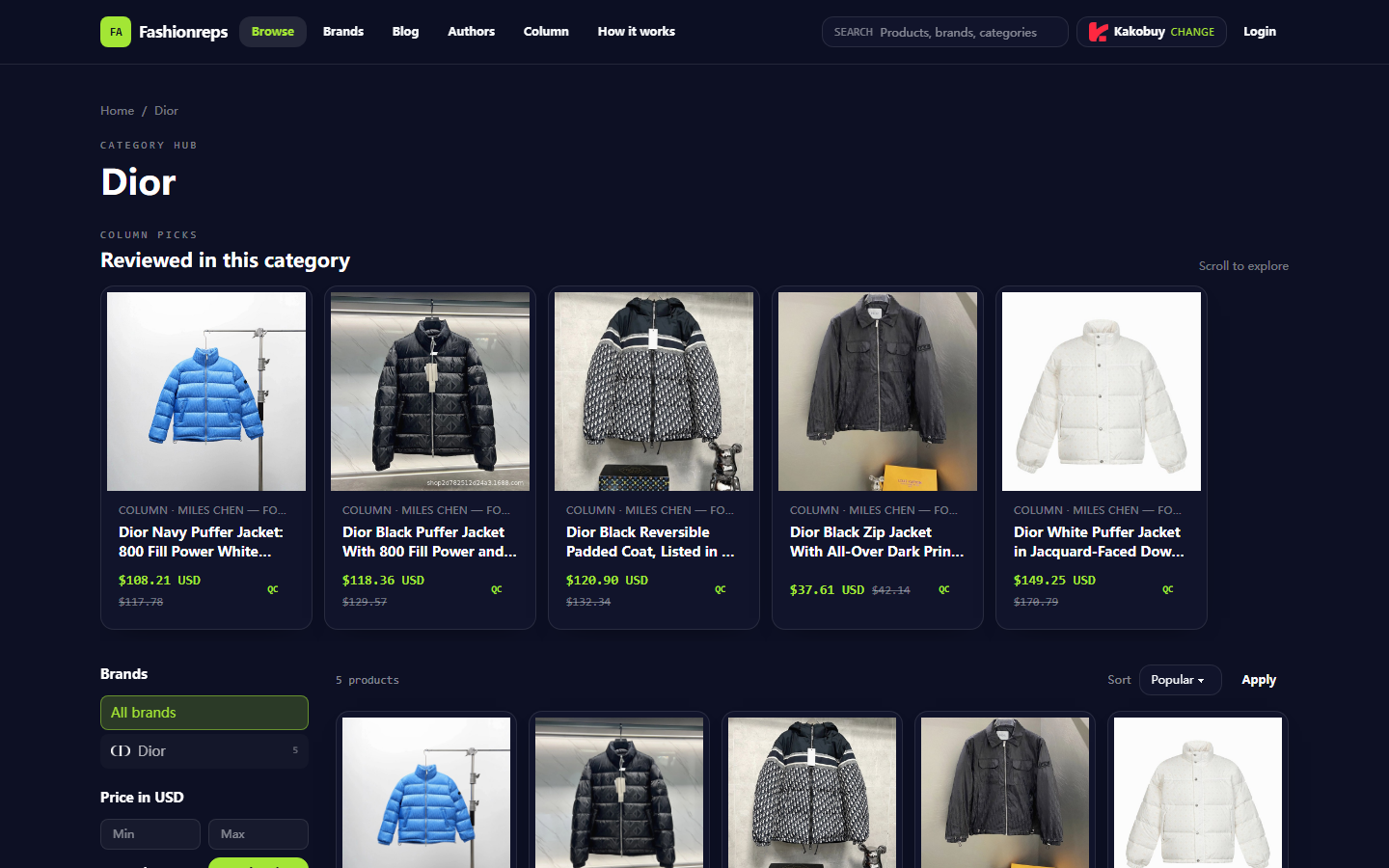
The provided Dior category page shows that the page displays product cards in a brand catalog format, rather than requiring users to create a table first. The currently visible Dior category page contains 5 products and offers brand filtering, price range filtering, and sorting options. Product cards display information such as product name, USD reference price, previous reference price, and QC markers.
Visible products on the page include:
- Dior Navy Puffer Jacket, labeled 800 fill power, white duck down, and low-temperature reference info.
- Dior Black Puffer Jacket, labeled 800 fill power and stand collar.
- Dior Black Reversible Padded Coat, page text labels S–3XL.
- Dior Black Zip Jacket, labeled all-over dark pattern, lapel, and chest pocket.
- Dior White Puffer Jacket, labeled jacquard surface, down filling, and four colorways.
This text can only serve as an initial screening basis at the catalog level. They cannot automatically prove current inventory, actual fill, garment measurements, seller page information, or final purchasability. Seeing "Listed in S–3XL" also does not directly infer that every size is in stock; you still need to open the product page for further confirmation. 🔎
How to view product cards, sizes, and images in the website catalog
The website-based catalog is suitable for discovering products first. You can check in the following order:
- First confirm that the brand or category at the top of the page is Dior to avoid mixing similar brands or generic search results into your list.
- Read the complete name on the product card and record the color, style, main material description, and size hints.
- View the images on the product card or product detail page to confirm that the images actually correspond to the current product, not other cards in the category page.
- Enter the product page and check for more specific size information, color options, product descriptions, and QC-related content.
- Record whether the page opens normally and whether the same product can be found after returning to the catalog.
The advantage of the catalog is that discovery and initial comparison are centralized in one place. You can first sort by price from low to high or high to low, then narrow down based on product name and images. The page also provides price filtering, making it suitable for quickly building a candidate set.
But product cards do not equal a complete size chart. For coats and down jackets, shoulder width, chest circumference, garment length, sleeve length, fit, and fill thickness are often more valuable than individual S, M, L labels. If the product page does not have this data, you should clearly mark "no garment measurements seen" in Google Sheets and not fill it in yourself.
How to organize Dior candidate items and size information in Google Sheets
Google Sheets is better for turning discovered products into a filterable, reviewable work list. It is recommended to create at least the following columns:
| Field | Content to record | Verification method |
|---|---|---|
| Product name | Keep the full name from the catalog | Check word by word against the product card |
| Color and style | For example, black, reversible, stand collar, or jacket | View product name and detail page |
| Page size hint | Record the size range explicitly written on the page | Do not treat the range as proof of inventory |
| Garment measurements | Shoulder width, chest, length, sleeve length, etc. | Fill in only if visible on the page |
| Image notes | Number of main images, detail images, or missing cases | Open product page to check |
| Product page | Save the corresponding product page entry | Separately check if it opens |
| Link status | Opens, redirects, broken, or pending review | Test on the recording date |
| Review date | Record using year-month-day | Update after each significant modification |
| Pre-order notes | Items that need to be asked or reconfirmed | Do not use guessed values instead |
When organizing, do not directly split "page says S–3XL" into seven rows and mark them all as buyable. A safer approach is to keep the original size range and add an "inventory confirmed" column. Only update inventory status when the product page clearly shows available sizes or when latest confirmation is obtained.
If multiple people organize together, one person can be responsible for transcribing catalog information, and another for opening product pages to review. Google Sheets' sharing and filtering features are suitable for this division of labor, but collaboration permissions should be set as needed to avoid anyone accidentally overwriting original records. ✅
How to separately verify product link copying, opening, and failure status
Copying successfully does not mean the link is valid. It is recommended to split link checking into three independent actions:
Step one is copying. After copying, immediately paste into the product page column of the table and check for extra spaces, truncated characters, or wrong cells.
Step two is opening. Open the link in a new browser tab and confirm that the page displays a clear Dior product name, not a blank page, category page, login page, or another product.
Step three is looking back. Return to the catalog or reopen the record to confirm that the product name, image, and link still correspond. If the page redirects, mark "redirect pending confirmation" in the table. Do not assume the original link is stable just because the browser eventually displays content.
You can use the following status values to keep records consistent:
- Opens: The page is accessible and shows product information that matches the record.
- Opens but insufficient info: The page exists but lacks enough size or image information.
- Redirect: The original entry jumps to another page; need to confirm if it is still the same product.
- Broken: 404, blank page, or unrecognizable product page appears.
- Pending review: Network, login, or page load issues prevent temporary judgment.
Do not replace these technical statuses with "ordered," "in stock," or "verified" unless you have actually completed the corresponding independent verification. A page opening does not mean the seller still has inventory or the purchasing platform accepts orders. 🔗
Comparison of applicable boundaries between website catalog and Google Sheets
| Verification task | Website-based product catalog | Google Sheets |
|---|---|---|
| Discover Dior products | More suitable, product cards centrally displayed | Requires first entering or importing candidate products |
| Initial screening by brand and price | Page already has filtering and sorting entry | Can create custom filter conditions |
| View images and product cards | More direct, suitable for browsing | Suitable for recording whether images exist, not a substitute for detail pages |
| Manage size and measurement data | Depends on product page content | More suitable for item-by-item recording and comparison |
| Check multiple links | Need to open one by one | Can save status, date, and review notes |
| Multi-person collaboration | Depends on the website itself | Suitable for sharing, division of labor, and keeping notes |
| Prove current inventory | Usually insufficient | Also cannot automatically prove inventory |
Therefore, the two are not tools that replace each other. The website catalog is for discovery and browsing, while Google Sheets is for organizing, filtering, reviewing, and leaving records. Treating the website page as a complete inventory table, or treating old links in the table as current product status, will cause misjudgment.
Verification limitations of product information, link update times, and QC evidence
Reference prices and previous reference prices in the catalog page are page display information and should not be treated as final payment amounts. Actual costs may also be affected by purchasing platform service fees, domestic shipping, international shipping, taxes, exchange rates, and destination country rules. This article does not provide real-time calculation of these fees, so catalog prices should not be used to derive the final budget.
Similarly, QC markers can only indicate that the page has a corresponding QC entry or section hint, and cannot automatically prove that a particular item has completed individual order inspection. Before ordering, distinguish the following types of evidence:
- Descriptions in the product catalog: for discovery and initial screening.
- Size information on the product detail page: for recording visible data.
- Warehouse photos or QC images for personal orders: for checking the actual received product condition.
- Inventory and order status on the purchasing platform: for confirming whether ordering and subsequent processing are possible.
If the table is used long-term, it is recommended to update the date with each review and keep old statuses instead of directly overwriting all historical records. This way you can see when links broke and when size information changed, and avoid mistaking old page content for current facts. 🕒
Pre-order action checklist after completing verification
- Confirm that the product name, color, and style match the Dior catalog card.
- Open the product page and confirm it is not a category page, empty page, or another product.
- Record the size range explicitly shown on the page; do not infer missing sizes yourself.
- Prioritize recording garment measurements; if no measurements, clearly write "no garment measurements seen."
- Check whether images belong to the current product and record whether detail images are missing.
- Record copying, opening, and looking back results separately; do not treat copying success as link validity.
- Write down the verification date and pending confirmation items for each record.
- Before ordering, review inventory, price, shipping, taxes, return conditions, and destination country restrictions.
- When actual size judgment is needed, compare your own body measurements with the garment measurements of the item, rather than relying only on letter sizes.
After completing these steps, the website catalog is suitable as a Dior product discovery entry, and Google Sheets is suitable as a personal verification and collaboration record. For buyers who just want to quickly browse styles, using the catalog directly saves organizing time; for buyers who need to compare multiple items, record size differences, or have others review, creating a table is better. Whichever method you choose, it is not recommended to order directly when links are broken, size data is insufficient, inventory is unconfirmed, or fee conditions are unclear.